
Let me begin this blog post by stating I am not a space weather expert. I strongly suggest you follow Dr. Tamita Skov (@TamitaSkov on X or SpaceWeatherWoman.com). Dr. Skov does an excellent job of presenting what is happening with space weather, which HF propagation depends on heavily.
If you are new to amateur radio, you may not have experienced the nadir of the previous sunspot cycle (cycle 24). Sunspot cycle 24 ended in 2020-21. We are currently in sunspot cycle 25. The progression and decline of a sunspot cycle is measured in the number of sunspots. Typically, as sunspots increase in number and intensity, the F1 and F2 layers of our ionosphere are more favorable for HF communications. This is especially true of the F1 layer which is responsible for most DX. Without stepping outside my paygrade, the higher HF bands (17-10 meters) are more dependent on the sunspot cycle. It follows a logical progression. Even at the bottom of a sunspot cycle, 17 meters can be open, but it can just as easily be closed for anything other than ground plane contacts. 15 meters may have a few openings in a month, whereas 12 and 10 meters may seem like they have disappeared. When they do open it is a mass celebration. But, alas, they can close just as quickly as they open.
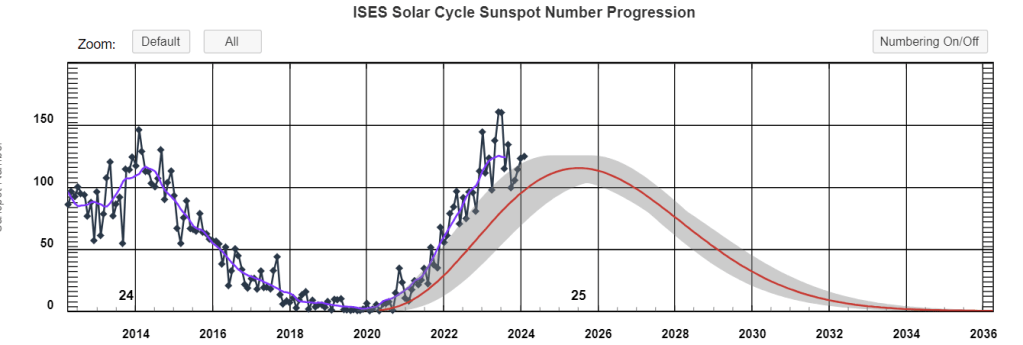
The Space Weather Prediction Center estimates that the apex of Sunspot Cycle 25 will sometime in 2025. So, for the next year or so, HF operators will have times when they will be catching DX by the bucket load. QRP will be the new kilowatt! In fact, it already is. This ham has been making daily contacts to Europe on 5 watts with a whip antenna on my vehicle. Most of those DX contacts have been made on 10, 12, and 15 meters. But I came back to the hobby right at the bottom of sunspot cycle 24. Openings on 10, 12, and 15 meters were rare. Most of my time was spent on 20, 30, and 40 meters. So, it was with a lot of excitement that I awaited the arrival of the current sunspot cycle feeding frenzy, and sunspot cycle 25 has not disappointed.
I have read many accounts on social media of QRP or low power conquests. It is a lot of fun to throw a wire over a tree and work the world on 5 watts. Ham radio manufacturers know the sunspot cycle as well as anyone. The time to launch new QRP or low power radio is just as a new sunspot cycle is beginning. But pay close attention to the used radio market. It will blossom with those same radios as this sunspot cycle starts to wane. While a 100-watt transceiver may only increase signal strength by 1-2 S units, that may be all the difference in making a QSO when the sunspot cycle has gone on vacation. Linear amplifiers can help, but portable operators such as myself have limited choices in that area.
This is a great time to enjoy the higher bands. Don’t let this opportunity pass by. However, it is also a great opportunity to master Morse code or learn digital modes. The CW and digital modes usually fare better than phone with challenged propagation.
 Radio Free Florida: K4NYM